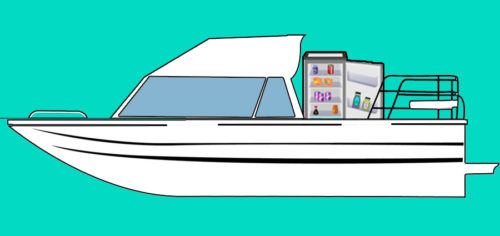
Propane fueled refrigerators are certainly less common than electrical refrigerators on boats, but if installed correctly (typically in a gimbal mount to keep them level and the correct venting arrangement for leaking gas) they are a highly effective means of refrigeration, although they aren’t without the potential to suffer faults from time to time…
Whilst certainly not as critical as something like a generator or navigation system that isn’t up to snuff, if your boat is fitted with a faulty refrigerator it can still be extremely problematic. When you’re out on the water during the height of summer you want to have access to cool drinks, and if you want to do any cooking you also need to be able to keep raw meats refrigerated as well.
When your refrigerator packs up it can be incredibly frustrating, not least because you’re faced with the slow realisation that you’ll have to throw all your spoiled food away and will be going hungry, but also because your boat ends up smelling like spoiled milk.
To add insult to injury you’ll probably have to fork out a whole lot of dough to get a service engineer out to your boatyard to fix the problem when you come ashore.
It’s not all bad news though! There are actually a few simple pieces of knowledge you can arm yourself with to help you get over any problems your refrigerator throws at you.
Leaking Coolant Solution
An electric refrigerator works by compressing a special refrigerant gas which is forced through narrow pipes, resulting in the gas turning into a liquid that absorbs heat and cools down the fridge.
A gas powered fridge on the other hand uses the heat of the flame to trigger a chemical reaction between ammonia and hydrogen gas, a reaction which conveniently absorbs heat from the inside of the refrigerator, thereby cooling things down nicely.
Problems arise when the ammonia and other chemicals within the refrigerant leak, as unsurprisingly it can prevent the heat absorbing chemical reactions from working properly.
The first thing you’ll likely notice when you have such a leak is the smell of ammonia, and further investigation may reveal that whilst the absorber tank (where the gas solution is turns from liquid to gas) is hot as expected but further along the pipes the temperature does not drop as expected.
Fixing this problem isn’t exactly simple, even if you’re able to plug the leak you’ll still need to refill and recommission the cooling unit (or it may even be better to simply replace it) which is a job best left to the professionals.
Ammonia Has Settled and Formed a Sediment at the Bottom of the Cooling Unit
If your refrigerator is a permanent fixture on your boat and you don’t head out on the water all that often then you might find you have issues when you come to use it after a prolonged period of non use. The trouble here is that the ammonia is not able to flow through the cooling unit as it should, meaning the cycle of chemical reactions that result in the cooling of the refrigerator cannot take place.
You’ll get a pretty good indication that this is the problem if you find the refrigerator seems to start cooling on first firing it up, only to find it gets progressively warmer to the point where it is worse than ineffective.
In some cases this could be game over for the fridge, but before you consign it to the skip there is one thing you can try that may work.
If you can disconnect the fridge from your boat safely you can then take it outside and place it upside down on the ground to try and encourage the pooled ammonia to get moving again. Leave it like this for an hour or so before setting it back up the right way for another hour before plugging it back in.
If you’re lucky doing this might just give the fridge the kick up the backside it needs to get going, if not then it might be time to call it quits and buy a new one.
Pilot Light Won’t Stay Lit
Unlike domestic refrigerators boat fridges don’t run on mains electricity, instead they run either on 12V from the boat house battery/generator or on propane gas. Some more expensive models can even run using either method depending on your preferences.
With a gas powered refrigerator sometimes the burner can fail. You might light it and find the fridge fires up just fine, only to find it back at room temperature a few hours later when the pilot light has gone out. You might find yourself relighting the pilot light over and over again as the problem continues, and ultimately doesn’t go away. This can be very frustrating, but there are a number of things you can do to troubleshoot the problem, and hopefully come up with a solution:
- Faulty thermocouple – this device determines the presence of the flame by sensing heat, if it isn’t working properly then it can cause the pilot light to go out by default as a safety feature. Swapping out this component isn’t a particularly costly process (around 20 bucks for the part and an hour and a half total required), but be sure to check the spares list in the fridge owners manual to make sure you choose the right one. Before you swap out the part ensure the gas valves are turned off, the electricity switched off (if applicable), and that the unit is allowed to cool for at least an hour before opening up the service panel to replace the thermocouple
- Too much air in the gas line – If this is the case then the flame won’t be getting the right mix of fuel required to light, but it’s a quick fix to rule out as an issue. Simply power down the gas valves and reset them to purge the system of air, and try firing it up again
- Clogged flue line – Sometimes soot and other crud can block the exhaust flue for the pilot light, leading to crud getting backed up and stuck in the pilot light chamber, which could prevent the flame from lighting. Also, I can’t imagine a flame that isn’t able to vent properly is particularly safe from the point of view that it could lead to incomplete combustion and the presence of deadly carbon monoxide, so it’s good practice to keep this part of the system clean as a matter of course.
Burner Failure
This one is less of an issue on board boats, at least boats used at sea that is. Propane doesn’t burn particularly well at altitude because the air is thinner and therefore there isn’t enough oxygen present to make the flame burn correctly.
Once you reach altitudes above 5550 feet you either need to make adjustments to the propane to fuel ration to make the fridge work correctly (if this is possible with your particular model of fridge), or power it electrically instead (again, if your fridge can be powered by electricity or gas. Failure to do so will result in a poor quality flame, sooty deposits, or burner failure.
This is unlikely to do lasting damage in the long term, and you may just need to reset the gas lines and clean the burners before you use the fridge again.
Unless you’re cruising somewhere like Lake Tahoe this isn’t likely to be a concern, but keep it in mind, especially if you own an RV as well as a boat. Some appliance manufacturers also offer ‘high altitude kits’ to change the ratio of gas to air, so this might be an option to you if you do operate at altitude.
Cooling Unit Frozen Solid
This is a potential concern if you live in a part of the world where temperatures drop to cripplingly low levels (-34°C or -30°F or lower), so if you’re up on the east coast of Canada or Alaska I can see this being a potential issue during winter.
Essentially what can happen is that the chemicals found in the cooling unit of a dormant fridge in a boat that reaches these temperatures may freeze, which will prevent you from being able to fire up the fridge.
Of course prevention is always better than cure, so if you know your boat will be left in the cold for the winter, removing the refrigerator will be one of the things you should consider doing before ‘powering down’ for the winter.
Nonetheless if you do need to thaw your refrigerator, it’s a good idea to do so slowly as bringing it up to temperature too quickly could result in fractures developing in the pipework. Use a fan heater on a low setting and blow air into the fridge to slowly thaw it out.